Why an $800 Moisture Test Prevents Paint Failure
Before any painting project begins, attention often turns to colors and finishes. Yet moisture within surfaces remains the leading cause of adhesion failure. A professional moisture test, typically priced near $800, detects hidden dampness that would otherwise ruin the finish.
Homeowners may question the expense. This step actually protects the full project investment by confirming that every surface meets the dryness standards required for lasting results.
How Moisture Testing Works
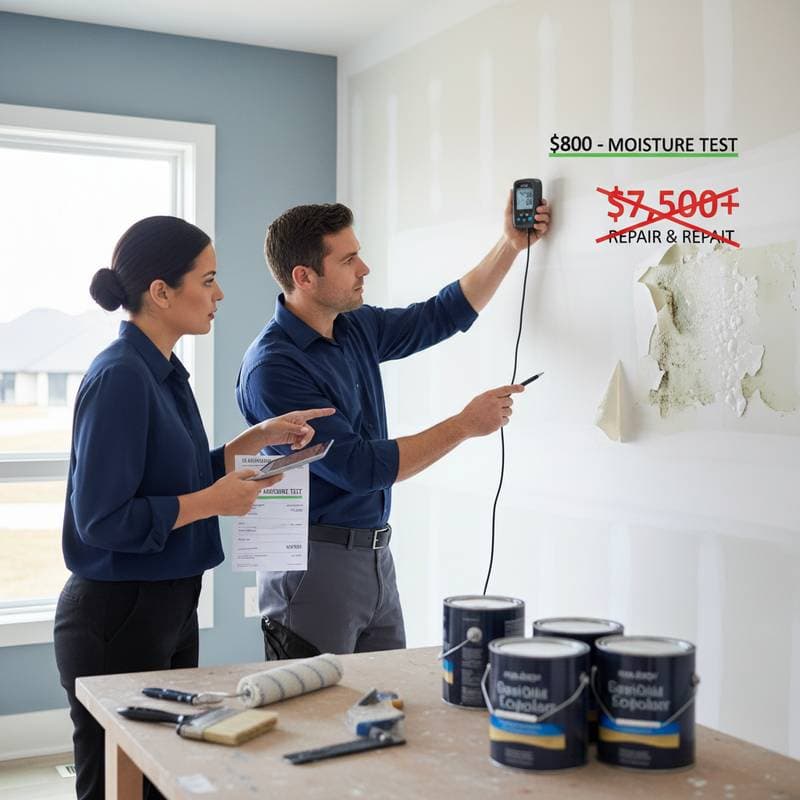
Moisture testing measures water vapor levels inside drywall, plaster, concrete, and wood. Technicians employ electronic meters, calcium chloride kits, and infrared sensors to locate problems invisible to the naked eye. Excess moisture leads to blistering, peeling, or discoloration soon after application.
The standard service includes a complete surface inspection, readings at multiple points, and a written report. The report states whether surfaces can accept paint or require drying, sealing, or replacement first.
Typical Cost Ranges
Fees vary with project size. Small areas such as one or two rooms usually fall between $400 and $600. Medium projects covering a full floor range from $600 to $900. Whole-home or commercial work often totals $900 to $1,200.
On a per-square-foot basis, testing averages $0.50 to $1.50. This covers equipment calibration, labor, and documentation. Rates adjust according to material type and access difficulty.
Elements That Influence Price
Several factors determine final cost. Concrete and plaster demand more sensitive equipment than drywall. Older buildings with prior leaks require extended inspection time. High ceilings or confined spaces add setup labor. Detailed reports with moisture maps increase the fee but supply clearer guidance for repairs.
How Moisture Damages Paint
Trapped water vapor escapes through the paint film and breaks the bond with the substrate. The result appears as blisters, flakes, or bubbles. In concrete, excess moisture creates alkaline deposits that push paint away. On wood or drywall, prolonged dampness supports mold that harms both finish and air quality. These defects commonly surface months later.
Long-Term Financial Impact
Skipping the test often leads to repairs that cost two to three times the original painting price. A single affected wall can require $1,000 or more to correct. Widespread failure across several rooms can exceed $5,000. The $800 test prevents these outcomes by verifying stable, dry conditions before work starts.
Ways to Control Testing Expenses
Schedule the test during initial surface preparation to avoid separate mobilization fees. Repair visible leaks beforehand. Test only rooms that show signs of prior moisture. Request electronic reports instead of printed copies. Ask the painting contractor about bundled rates with inspection partners.
Budget Planning Steps
Treat moisture testing as a required line item equal to 5 to 10 percent of the total painting budget. For an $8,000 project, reserve $800 specifically for testing. This allocation confirms proper adhesion and extends finish life in humid areas such as basements and bathrooms.
Answers to Common Questions
What is the average cost of a moisture test before painting? Most residential jobs fall between $600 and $900. Larger or more complex properties reach $1,200.
Which factors affect cost the most? Surface material, chosen test method, building age, and report detail level drive the largest differences.
Can testing accuracy be maintained while lowering cost? Limit the scope to known problem areas, coordinate timing with the painter, and accept digital reports.
Is professional testing worth the price compared with DIY meters? Handheld consumer devices provide only rough indications. Certified inspectors use calibrated instruments and interpret data correctly.
How should unexpected moisture findings be funded? Maintain a contingency of 10 to 15 percent of the painting budget to cover drying or repairs without schedule delays.
When should testing occur? Complete all measurements before priming or painting begins so any required corrections happen early.