Sanding Costs Surge 60%: Innovative Tools Halve Prep Time
Sanding expenses have risen sharply, affecting professionals and DIY enthusiasts alike. Fortunately, advanced tools now reduce preparation time by half. This decrease in labor hours lowers overall project costs and facilitates smoother finishes with less effort. For tasks involving drywall, cabinetry, or general surface preparation, these innovations transform efficiency calculations. The following sections examine the reasons for the cost increase and strategies to maintain a competitive edge through effective technology.
Reasons for the Rise in Sanding Costs
Painters and finishers encounter escalating material prices regularly. Sanding discs, sheets, and abrasives contribute to this trend, influenced by transportation expenses, supply chain disruptions, and growing demand for high-quality surfaces. Labor represents an additional burden, as sanding demands repetitive effort and consumes significant time, particularly for walls or trim requiring multiple applications.
Preparation often accounts for half of a project's total duration. Even modest increases in abrasive costs amplify the financial impact across an entire job. A 60% surge translates to substantial losses per room. However, emerging tools address this imbalance effectively.
Advanced Tools Reducing Prep Time by Half
Technological advancements target the challenges of surface preparation. Electric sanders, dust extraction systems, and mesh abrasives enhance speed while preserving finish quality. These solutions apply consistent pressure and minimize inconsistencies.
1. Brushless Motor Sanders
Brushless sanders operate longer, generate less heat, and sustain steady revolutions per minute under resistance. This results in even strokes and reduced user fatigue. Professional random orbital models with automatic speed adjustment allow seamless transitions between drywall and door surfaces without tool changes. Compact edge sanders with adaptable heads simplify trim preparation in confined areas.
-
Budget-friendly choice: Ergonomic manual sanding blocks paired with reusable mesh sheets, ideal for minor adjustments and clean operation.
-
Moderate investment: Corded random orbital sanders featuring dust ports, compatible with shop vacuums to improve air quality and shorten cleanup.
-
Premium selection: Cordless brushless units with adjustable speeds and built-in dust collection, offering rapid returns on investment through time savings.
2. Integrated Vacuum Dust Control Systems
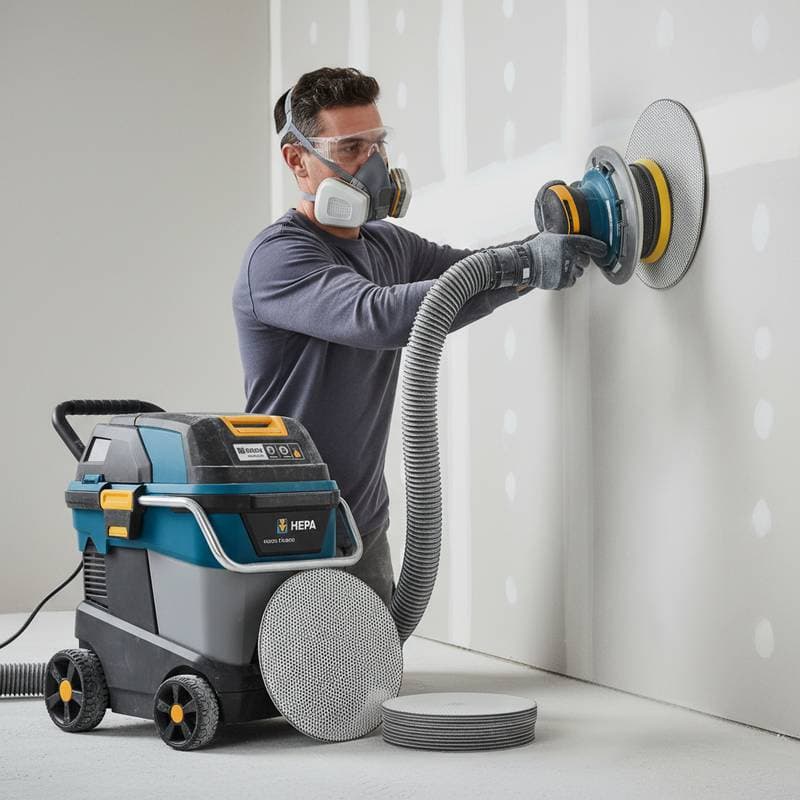
Dust accumulates as a hidden expense, prolonging tasks, necessitating extra cleaning, and potentially compromising fresh applications. Systems that link vacuums directly to sanders capture particles at the source, preventing dispersion. Cleaner air enhances finish uniformity, mitigates health risks, and eliminates extensive post-preparation wiping.
3. Mesh Abrasives and Durable Pads
Conventional paper discs clog quickly, leading to frequent replacements. Mesh abrasives permit dust to flow through, extending usability several times over. This reduces supply expenditures and interruption from sheet changes. Options span coarse, medium, and fine grits, suitable for drywall joints, wood textures, or metal surfaces. Select reputable brands ensuring even grit distribution for dependable performance.
Effects on Project Workflow
Halving sanding duration creates widespread benefits. Teams proceed to priming or painting earlier, accelerating client deliveries without quality compromises. Smoother surfaces improve visual appeal in presentations or recordings. In production settings, thorough preparation minimizes lighting challenges and subsequent edits.
Small contractors gain capacity for additional projects within fixed schedules. Independent professionals experience notable productivity boosts. DIY participants complete tasks more swiftly, such as finishing an afternoon endeavor before evening. These gains foster a sense of accomplishment alongside professional-grade results.
Achieving Optimal Results for Visual Media
Surface preparation determines the success of photographic or video projects. High-gloss or reflective finishes highlight flaws prominently. Consistent, even, and dust-free sanding ensures projects capture beautifully.
Harsh lighting accentuates surface irregularities, making a refined base essential for vibrant color rendition. Employ raking light to evaluate walls prior to coating. Uneven areas become evident under this scrutiny. Consider using a headlamp or attachable LED for precise inspection; a surface that passes this check will perform well in any condition.
Strategic Investments in Surface Preparation
Tool acquisitions represent investments rather than mere costs. Amid rising sanding expenses, professionals prioritize equipment that delivers value over numerous jobs. A cordless sander saving one hour daily recovers several hours weekly, equating to a full billable day monthly.
For developers or workshop managers, these trends create market opportunities. Demand grows for superior abrasives, ergonomic designs, and adaptable dust solutions. Partnerships with suppliers or custom manufacturing yield tailored products. Reliability underpins success when quality defines the outcome.
Selecting Materials and Techniques
Effective preparation begins with material knowledge. Drywall, plaster, wood, and metal respond uniquely to abrasion. Incorrect grit or excessive force damages surfaces. Initiate with light pressure, test on small sections, and progress gradually.
-
Drywall: Apply 120-grit mesh to eliminate ridges, followed by 220-grit for paint readiness.
-
Wood: Progress from 80-grit for initial shaping to 150-grit for refinement, always following the grain direction.
-
Metal: Opt for fine-grit discs and maintain motion to avoid heat buildup and distortion.
Environmental factors like humidity, temperature, and illumination affect perceived smoothness. Verify under natural daylight or neutral LED sources for true assessment.
Prioritizing Safety and Ergonomics
Sanding involves physical demands despite its straightforward appearance. Ergonomic features prove essential. Wear cushioned gloves, knee pads for ground-level work, and respirators where dust capture falls short. Contemporary tools incorporate balanced designs to alleviate wrist stress during extended use. Comfort sustains precision throughout the workday.
In compact or residential settings, noise levels warrant consideration. Updated brushless motors operate more quietly, allowing professional results without disturbing surroundings.
Planning Upgrades Within Budget Constraints
Rising costs may tempt postponing enhancements, yet this approach incurs greater long-term expenses. If sanding comprises 40% of labor allocation, reducing it by half yields quick recoveries. Focus on high-impact items: dustless setups, extended-life abrasives, and dependable cordless tools. Introducing one advanced sander influences the entire team's efficiency.
For limited funds, integrate upgrades incrementally. Target the most time-intensive phase, such as drywall or door work. Cumulative improvements build momentum.
Sustaining Long-Term Finish Quality
Silk-smooth surfaces post-painting simplify upkeep. Dust removes easily, coatings endure longer, and fixes remain minimal. Proper preparation, though unseen, elevates every hue and pattern. As expenses climb, efficient tools democratize access to enduring design excellence.
Mastering these techniques ensures every project benefits from streamlined preparation.