Why Bio-Based Paints Cost 30 Percent More Yet Last Twice as Long
Homeowners pursuing healthier and more sustainable interiors increasingly select bio-based paints. These options stand out for low toxicity, diminished carbon emissions, and exceptional durability. Although they cost approximately 30 percent more than conventional latex or oil-based paints, the reasons tie directly to their composition, production, and performance. Grasping these elements enables informed choices that align initial expenses with enduring benefits.
Bio-Paint Cost Overview
Bio-based paints generally price at $50 to $90 per gallon, whereas traditional interior paints fall between $30 and $60 per gallon. For a typical interior project, expect $3 to $6 per square foot with bio-paint, versus $2 to $4 per square foot for synthetic alternatives. This elevation stems from renewable components, sophisticated formulas, and elaborate manufacturing.
Average Cost Ranges by Project Size
- Small room (150 sq. ft.): $450 to $900
- Medium room (300 sq. ft.): $900 to $1,800
- Large room (500 sq. ft.): $1,500 to $3,000
Estimates cover materials, professional labor for two coats, and basic preparation.
Cost Breakdown per Square Foot
Bio-paint applications average $3 to $6 per square foot, comprising:
- Materials: $1.50 to $3 per square foot
- Labor: $1.25 to $2 per square foot
- Surface preparation: $0.25 to $0.75 per square foot
- Additional factors: $0.25 to $0.50 per square foot
Factors Affecting Bio-Paint Costs
Several elements elevate bio-paint prices, each underscoring long-term advantages.
1. Ingredient sourcing
Bio-paints incorporate natural elements like linseed oil, clay, casein, and plant resins. These renewable, biodegradable materials demand higher sourcing and refinement costs than petrochemical binders in synthetic paints. Producers adhere to ethical cultivation and harvesting, further increasing expenses.
2. Manufacturing complexity
Formulating reliable bio-paint demands meticulous control, as natural ingredients fluctuate in viscosity, color, and texture based on harvest variations. Advanced filtration and blending secure consistency, accounting for much of the 30 percent markup.
3. Certification and testing
Certifications confirm low volatile organic compounds, biodegradability, and non-toxicity through rigorous third-party evaluations. Such validations enhance safety and eco-credentials, embedding costs into the final price.
4. Durability and lifespan
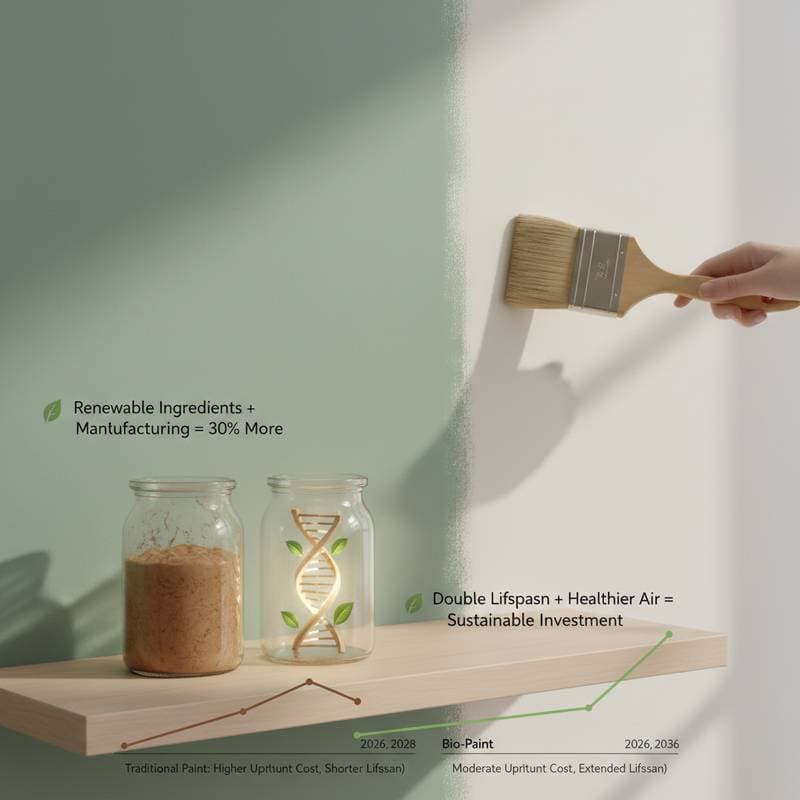
Bio-paints endure up to twice the duration of standard options. Natural resins and oils form a resilient, adaptable layer resistant to cracks and fading, thereby decreasing repaint needs and yielding material and labor savings.
5. Market scale
Large-scale traditional manufacturers benefit from volume efficiencies, unlike bio-paint firms targeting niche markets with constrained distribution. Expanded demand will likely moderate prices over time.
Detailed Cost Analysis by Quality Level
| Quality Level | Basic Range | Standard Range | Premium Range | Key Differences |
|---|---|---|---|---|
| Bio-based interior paint | $45 to $60 per gallon | $60 to $80 per gallon | $80 to $100 per gallon | Premium variants feature purified natural oils, superior pigments, and amplified longevity |
| Conventional latex paint | $25 to $40 per gallon | $40 to $55 per gallon | $55 to $70 per gallon | Synthetic bases emphasize petrochemicals and rapid drying |
Premium bio-paints provide better coverage, yellowing resistance, and air purification. A $30 per gallon gap narrows with infrequent repaints.
Detailed Cost Breakdown for a Typical Room
Medium Room (300 sq. ft.)
Total expenses range from $900 to $1,800:
- Bio-paint materials: $270 to $480
- Professional labor: $375 to $900
- Surface preparation: $75 to $150
- Additional factors (repairs, primers, trim): $180 to $270
Assumptions include standard heights, two coats, and typical conditions. Complex repairs or custom elements may raise costs by 10 to 25 percent.
Why Bio-Paints Last Longer
Bio-paint endurance arises from unique chemistry and curing. Oils like linseed and tung penetrate surfaces deeply, creating flexible bonds that accommodate thermal shifts and prevent cracking or peeling. Synthetic paints, by comparison, develop brittle films prone to failure under strain.
Mineral pigments in bio-paints maintain color stability against UV exposure, outperforming fading synthetic dyes. Their breathability regulates moisture to avert blistering and mold, issues that plague conventional coatings. Repaint intervals stretch from 5 to 7 years to 10 to 14 years, halving long-term expenses and waste.
Value and Return on Investment
Long-Term Savings
The 30 percent premium proves economical given extended use. For a 2,000-square-foot home:
- Conventional paint: $6,000 initial, repainted every 6 years totals $18,000 over 18 years
- Bio-paint: $8,000 initial, repainted every 12 years totals $16,000 over 24 years
Fewer disruptions and less waste amplify these gains.
Health and Environmental Benefits
Minimal volatile organic compound emissions purify indoor air, benefiting those with allergies or sensitivities. Petroleum avoidance cuts carbon output and pollution, delivering non-monetary rewards.
Market Appeal
Eco-materials boost real estate desirability. Bio-paint contributes to sustainable profiles that draw health-conscious buyers.
Money-Saving Strategies
-
Compare brands carefully
Examine compositions and reviews from independent makers for optimal value. -
Use bio-primers selectively
Pair with low-volatile organic compound primers where feasible to trim expenses while preserving benefits. -
Do partial DIY work
Manage tasks like cleaning or patching to shorten professional labor. -
Schedule off-peak projects
Book during low-demand seasons for discounted rates. -
Buy in bulk
Acquire extras for future needs, leveraging volume discounts. -
Focus on high-traffic areas first
Target kitchens and bathrooms to maximize durability returns.
Planning Your Budget
Start by measuring surfaces and multiplying by per-square-foot rates, adding 10 to 15 percent for contingencies. Request quotes detailing materials, coats, preparation, labor splits, and warranties.
Sample Budget Framework
| Cost Category | Estimated Range | Notes |
|---|---|---|
| Paint materials | $1.50 to $3 per sq. ft. | Covers bio-based paint and primer |
| Labor | $1.25 to $2 per sq. ft. | Includes application and cleanup |
| Preparation | $0.25 to $0.75 per sq. ft. | Encompasses patching, sanding, masking |
| Contingency | 10 to 15 percent of total | Accounts for unforeseen issues |
This framework safeguards against overruns.
Professional vs DIY Approach
Bio-paint demands standard techniques but accounts for extended drying and mixing. Experts ensure even application and peak performance. DIY suits small areas with care, though full projects benefit from pros to realize full lifespan potential.
Getting Started with Your Project
Prioritize low-volatile organic compound certifications and natural binders for sustainability and durability. Test samples on inconspicuous spots. Partner with bio-paint-savvy painters for primers, methods, and upkeep advice to optimize outcomes and value.
Frequently Asked Questions
What sets bio-paints apart in terms of ingredients and performance?
Bio-paints rely on plant oils, minerals, and casein for low toxicity and flexibility, outperforming synthetics in longevity and air quality.
How much can I save long-term with bio-paints?
Extended durability halves repaint frequency, potentially saving thousands over a decade through reduced labor and materials.
Are bio-paints suitable for all surfaces?
They excel on walls and trim but verify compatibility for high-moisture areas like bathrooms, often requiring specific primers.
When is the best time to start a bio-paint project for lowest costs?
Opt for transitional seasons when contractor schedules ease, yielding lower rates and faster service.