Sanding Drywall Without the $800 Dust Disaster
Drywall sanding appears straightforward at first glance. One might select a pole sander and sandpaper, then proceed. However, this process frequently results in extensive dust accumulation, leading to cleanup expenses that reach hundreds of dollars. Homeowners have encountered situations where dust coats ceilings and furniture, while professionals dedicate full days to restoration rather than advancing to painting. Proper preparation, tools, and methods enable a smooth finish without pervasive powder throughout the home.
A clean workspace supports flawless surfaces. The following steps ensure dust containment and efficient progress.
Preparation: Establish a Controlled Workspace
Effective preparation forms the foundation of successful sanding. Treat the area as a contained zone to minimize dust escape.
Seal the Work Area
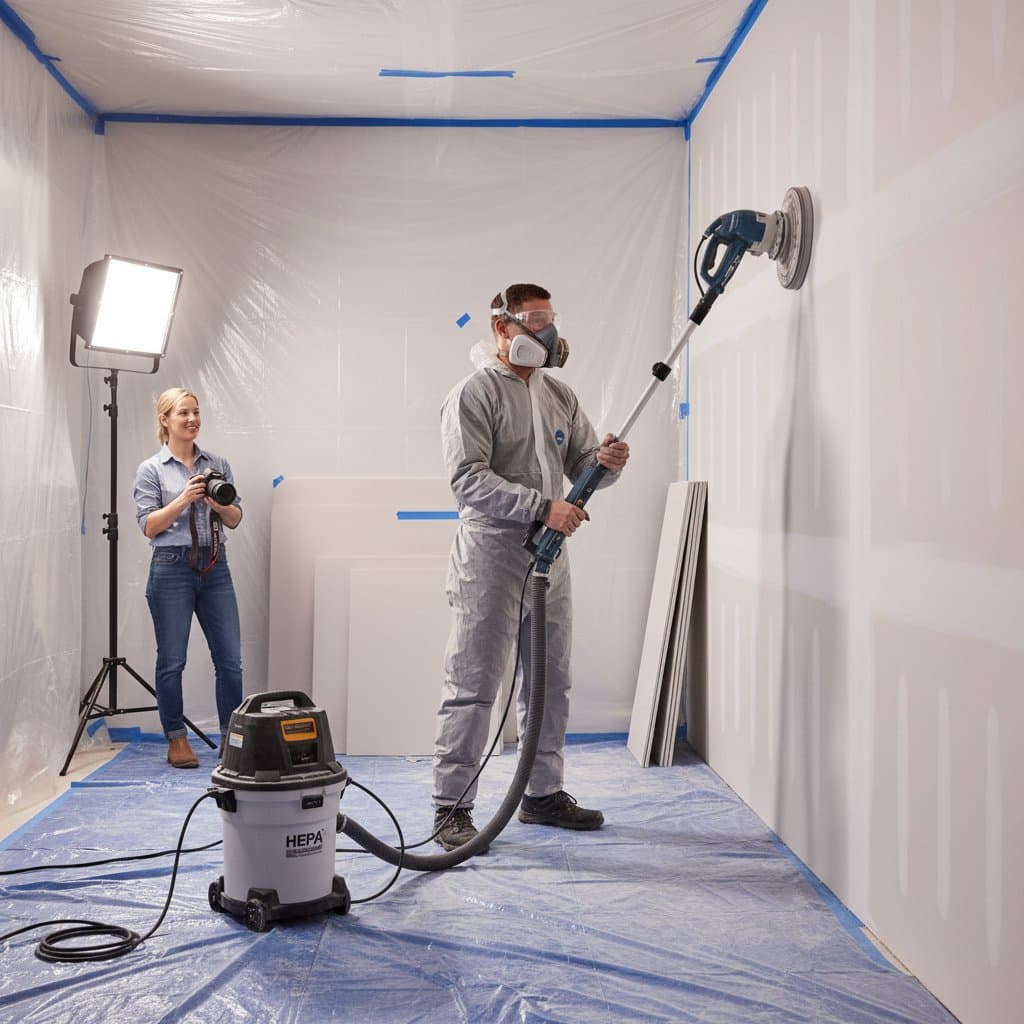
Close all doors to isolate the space. Apply painter's tape along seams and suspend plastic sheeting from ceiling to floor. Zippered plastic barriers facilitate easy access and allow reuse. In open layouts, construct a temporary partition using tape and polyethylene sheets to form an effective dust barrier.
Protect Vents and Fixtures
Cover heating, ventilation, and air conditioning vents entirely. An exposed vent disperses dust across the house. Secure magnetic covers or affix plastic sheets with tape. Remove light fixtures when feasible and wrap others; deactivate ceiling fans to prevent circulation.
Verify Surface Readiness
Confirm that the drywall compound has dried completely. Damp material clogs sandpaper and produces irregular surfaces. Test by touching the area; if it remains cool or appears darker, allow additional drying time. This step reduces the need for subsequent corrections.
Essential Tools for Dust Control
Selecting appropriate equipment prevents dust proliferation. Invest in items that capture particles at the source.
Basic Sanding Implements
Begin with a pole sander for reach and a selection of sandpaper grits, starting at 120 for initial passes and progressing to 220 for finishing. Sponges suit detailed edges and corners. A shop vacuum with a fine-particle filter handles immediate debris removal.
Dust Management Accessories
Attach a vacuum sander head to connect directly to a HEPA-filtered vacuum. Microfiber cloths capture residual particles without spreading them. Portable work lights with adjustable angles highlight imperfections during the process.
Advanced Options
Consider a battery-powered orbital sander with integrated dust collection for efficiency. An air scrubber circulates and filters airborne particles, maintaining air quality in larger areas.
Sanding Techniques for Professional Results
With the workspace secured and tools assembled, apply controlled methods to achieve even surfaces.
Apply Light, Even Pressure
Excessive force damages the compound and creates furrows. Guide the sander with consistent, overlapping strokes. Approach the task as a polishing motion rather than aggressive abrasion.
Employ Circular or Feathering Motions
Circular patterns integrate patches seamlessly, outperforming linear strokes. Feather the edges where compound adjoins the drywall paper to ensure imperceptible blends under paint.
Utilize Side Lighting
Position a portable light at a shallow angle to the wall. This illumination exposes ridges, depressions, and overlooked areas. Professionals rely on this method to identify flaws prior to finishing.
Monitor Progress Frequently
Pause periodically to clean the surface with a soft cloth. Streaks indicate clogged sandpaper; replace it promptly to avoid scratches or tears in the compound.
Inspection and Final Adjustments
Thorough evaluation precedes painting and determines the quality of the outcome.
- Pass your hand along seams to detect irregularities; the surface must feel uniform.
- Apply side lighting once more; shadows signal the need for additional fine-grit sanding.
- Select a premium drywall primer to seal the surface and balance absorption. Remaining dust trapped in primer diminishes paint vibrancy.
Address pinholes or roughness post-priming with minimal patching, followed by drying and light sanding. This process yields enduring smoothness.
Cost-Effective Strategies by Budget Level
Smart investments control expenses while ensuring cleanliness. Tailor approaches to available resources.
Low-Budget Approach
Utilize a manual sander, sanding sponge, and plastic drop cloths. Perform frequent vacuuming with a standard unit equipped with a disposable fine filter. This method demands more effort but incurs minimal costs.
Mid-Budget Approach
Acquire a vacuum attachment for sanders and a HEPA shop vacuum. Incorporate reusable plastic barriers and microfiber cloths. These tools halve cleanup duration.
High-Budget Approach
Purchase a complete drywall sander system with suction capability. Include an air purifier or scrubber. Initial outlay offsets savings in time and superior finish quality.
Regardless of budget, prioritize dust containment for smooth results, respiratory safety, and reduced stress.
Advanced Techniques for Superior Finishes
Experience on set constructions and renovations underscores the importance of precision. Even minor imperfections become prominent under intense lighting. Dust-free sanding produces surfaces that appear silky and professional, suitable for photography or daily appreciation.
Even paint application depends on underlying smoothness. Professionals achieve this through meticulous preparation, earning praise for results that enhance visual appeal.
Practical Tips for Consistent Outcomes
These strategies distinguish novice efforts from expert work.
- Sand during daylight hours when available; natural light uncovers flaws more effectively than artificial sources.
- Mark grit levels on sander handles for quick changes without error.
- Seal unused joint compound in airtight containers to prevent hardening from moisture exposure.
- Test readiness by wiping a test area with a damp cloth; cleanliness confirms suitability for priming.
- Maintain a dry paintbrush for removing dust from crevices and joints prior to sealing.
Adopting these practices fosters reliability and satisfaction in every project.
Sustaining Your Finished Surfaces
After sanding and painting, simple care preserves the appearance. Keep microfiber cloths available for light dusting. Refrain from abrasive cleaning to prevent paint wear. For repairs, apply patches with feathered edges and replicate dust-control measures. This maintains the even, luminous quality over time.
Well-maintained walls enhance room ambiance. They distribute light evenly, intensify colors, and convey a polished aesthetic that elevates the space.