Why Vaulted Ceilings Cost 30 Percent More to Paint
Painting vaulted or cathedral ceilings dramatically enhances a room's appearance, though the associated expense often catches homeowners off guard. These elevated architectural elements demand additional time, specialized equipment, and meticulous precision compared to standard flat ceilings. Professionals typically charge about 30 percent more for vaulted ceilings than for equivalent square footage on flat surfaces. Grasping the reasons behind this premium enables homeowners to forecast expenses accurately and assess contractor bids effectively.
Average Cost Ranges by Ceiling Height
The intricacy of vaulted ceilings escalates with both elevation and configuration. Professional painting costs vary based on height, as outlined below:
- Standard 8-foot ceiling: $1.00 to $2.50 per square foot
- High 10- to 14-foot ceiling: $2.50 to $4.00 per square foot
- Vaulted or cathedral ceiling above 14 feet: $3.50 to $6.00 per square foot
These figures encompass labor, paint application, and preparatory work. For a typical 350-square-foot vaulted living room, expect total expenses from $1,200 to $2,000, whereas a comparable space with a standard ceiling ranges from $900 to $1,400.
Cost Breakdown per Square Foot
Vaulted ceiling projects incorporate several key elements:
- Materials: $0.75 to $1.50 per square foot
- Labor: $2.00 to $4.00 per square foot
- Preparation and masking: $0.50 to $1.00 per square foot
- Equipment and safety setup: $0.25 to $0.75 per square foot
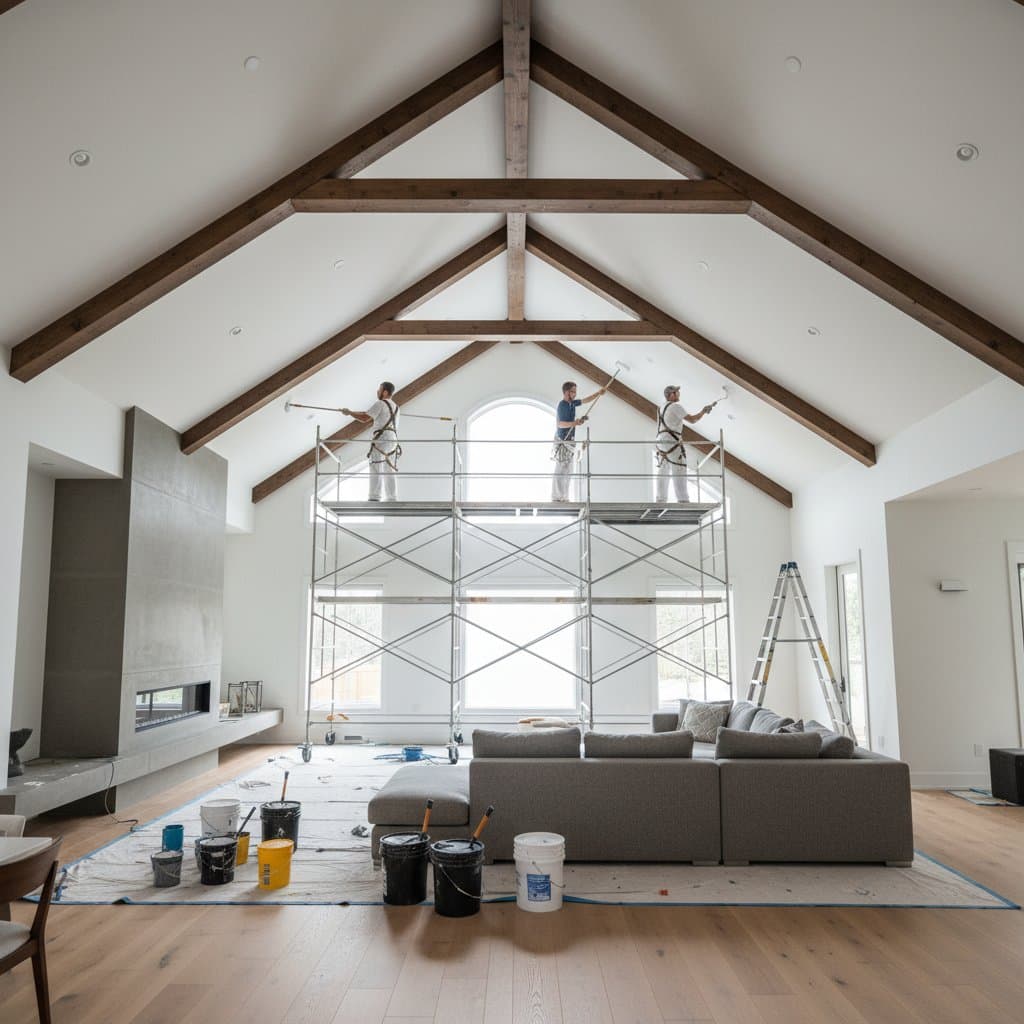
Elevated labor and equipment demands primarily account for the price uplift. Professionals must operate at significant heights, frequently employing scaffolding or extended ladders, which extends project duration and heightens safety protocols.
Factors Affecting Vaulted Ceiling Painting Costs
Multiple elements contribute to the disparity in pricing between vaulted and standard ceiling endeavors.
Ceiling Height and Access
Height stands as the primary influence. Painters rely on specialized ladders, scaffolding, and harnesses to access elevated areas securely. Establishing this infrastructure requires substantial time, and frequent adjustments prolong labor. A ceiling reaching 18 feet might demand twice the effort of an 8-foot counterpart with identical surface area.
Surface Area and Angles
Vaulted designs expand the paintable area beyond flat equivalents. Inclined surfaces boost total square footage by 15 to 25 percent, necessitating more paint. Intricate angles and ornamental beams call for precise brush techniques, intensifying labor requirements.
Lighting Fixtures and Architectural Details
Vaulted ceilings frequently feature skylights, recessed lighting, or structural beams. Masking these components or painting around edges extends workflow. Dismantling and reinstalling fixtures may incur additional charges of $50 to $150.
Paint Type and Finish
Elevated ceilings pair well with durable, reflective paints that command higher prices per gallon. Such products minimize future upkeep. Satin or semi-gloss options amplify illumination but demand flawless application to prevent noticeable imperfections, thereby extending labor.
Regional Labor Rates
In regions with elevated wages or scarce skilled labor, vaulted ceiling rates can surpass $6 per square foot. Factors like local market dynamics, living expenses, and workforce availability shape these variations.
Detailed Cost Analysis by Finish Quality
Finish selections influence expenses, with premium options offering longevity. The table below compares ranges:
| Finish Type | Basic Range | Standard Range | Premium Range | Key Differences |
|---|---|---|---|---|
| Flat or matte | $3.00 - $4.00 | $4.00 - $5.00 | $5.00 - $6.00 | Economical and conceals flaws but resists cleaning less effectively |
| Eggshell | $3.25 - $4.25 | $4.25 - $5.25 | $5.25 - $6.25 | Subtle luster enhances light diffusion |
| Satin or semi-gloss | $3.50 - $4.75 | $4.75 - $5.75 | $5.75 - $6.50 | Resilient and luminous yet accentuates surface irregularities |
| Specialty finishes | $4.00 - $5.50 | $5.50 - $6.50 | $6.50 - $7.00 | Encompasses textured or simulated effects |
Higher-end finishes demand greater initial outlay but withstand wear better, proving advantageous in frequented spaces like living areas and kitchens.
Why the 30 Percent Increase Makes Sense
The premium largely stems from prolonged timelines and specialized gear for elevated work. Scaffolding rental or transport alone may add $100 to $300. Installation and removal processes absorb hours absent in flat-ceiling tasks. Moreover, achieving uniform coverage at heights proves challenging, as irregularities become prominent from ground level. Height, geometry, and precautionary measures collectively elevate expenses.
Value and Return on Investment
Despite the added cost, vaulted ceiling painting yields substantial aesthetic and financial returns. Renewed paintwork brightens interiors, accentuates design elements, and expands perceived room dimensions. Prospective buyers regard vaulted ceilings as upscale attributes, with fresh coatings preserving contemporary allure. Quality applications endure up to a decade, particularly with superior materials, deferring subsequent repaints.
Money-Saving Strategies
Homeowners can trim expenses while upholding standards through proactive measures and judicious selections:
- Relocate lightweight furnishings and perform initial cleaning prior to crew arrival, curtailing billable hours.
- Select mid-level paints offering solid coverage and resilience over luxury lines.
- Book projects in low-demand seasons, prompting negotiable pricing from contractors.
- Bundle services like wall and trim painting into a single session to amortize setup fees.
- Opt for pale hues, which typically require fewer layers than intense colors.
These approaches diminish labor duration and material overuse, yielding polished outcomes.
Planning Your Budget
Effective budgeting begins with measuring the ceiling's square footage and noting heights, angles, and features like beams or fixtures. Obtain at least three detailed quotes from licensed painters, specifying inclusions such as preparation and cleanup. Factor in a 10 to 15 percent buffer for surprises, like surface repairs or additional primer coats. Track local rates via industry associations to ensure fair pricing, and prioritize contractors with vaulted ceiling experience for reliable estimates.
Frequently Asked Questions
What Is the Average Cost to Paint Vaulted Ceilings?
Homeowners generally allocate $3.50 to $6.00 per square foot. For a midsize vaulted living room, totals span $1,200 to $2,000, influenced by elevation, intricacy, and finish caliber.
What Factors Have the Biggest Impact on Vaulted Ceiling Painting Costs?
Primary drivers include height, accessibility challenges, expanded surface area, and details such as beams or skylights. Each extends labor duration, amplifying total charges.
How Can I Save Money on Painting My Vaulted Ceiling?
Advance space preparation, mid-range paint choices, and task consolidation cut setup expenses. Off-season scheduling often secures reduced labor fees.
Should I Hire Professionals or Attempt to Paint a Vaulted Ceiling Myself?
Elevated work involves ladders, scaffolding, and safety gear, alongside precise handling. Professionals possess necessary tools and skills, rendering DIY less economical and riskier for most.
How Do I Budget for Unexpected Costs in Vaulted Ceiling Painting?
Reserve 10 to 15 percent above the estimate for contingencies like repairs, primers, or fixture handling, which can incrementally raise project totals.
When Is the Best Time to Paint Vaulted Ceilings for Lower Prices?
Low-demand intervals, including late winter or early spring, yield preferential rates. Advance reservations and scheduling flexibility facilitate cost reductions.